Building a home gym under $100 is not about finding the cheapest version of a commercial gym. It is about buying the four pieces of equipment that cover every movement pattern your body needs, in the right order, and ignoring everything else until those four are worn out.
Most cheap home gym guides hand you a list of fifteen products and leave you to work out the priorities. That is backwards. When the budget is fixed at $100, the order you buy in matters far more than the brand you choose. This guide is built as a sequence: the first purchase is the one that would still be worth making if it were the only thing you ever bought.
Key takeaways
- A complete home gym under $100 needs four items: a resistance band set, an exercise mat, a pull-up bar or suspension trainer, and a jump rope.
- Spend roughly 40% of the budget on resistance, 25% on flooring, 20% on pulling and 15% on conditioning.
- Resistance bands are the highest-value purchase because they add progressive load, which bodyweight training alone cannot do.
- Skip adjustable dumbbells, benches, ab rollers and vibration plates at this budget — they consume most of $100 and deliver the least.
- The whole setup fits in roughly 2 × 2 metres of floor space and stores in a single basket.
On this page
- What a home gym under $100 actually gets you
- The $100 budget split
- Best budget home gym equipment: the four essentials
- Cheap home gym equipment to skip
- Building a home gym in a small apartment
- A 3-day workout plan using only this kit
- How to make a $100 budget stretch further
- Is a home gym under $100 worth it?
- Frequently asked questions
The $100 budget split: where every dollar should go
The $100 split
Allocation by share of budget, not by sticker price. Prices move constantly, so treat these as proportions and check current pricing before you buy.
- ~40%Resistance — a stackable band set with handles and a door anchor
- ~25%Flooring — a mat you can kneel and press on without pain
- ~20%Pulling — a doorway pull-up bar or suspension trainer
- ~15%Conditioning — a jump rope, and nothing more elaborate
1. Resistance band set — the best value strength equipment for home workouts
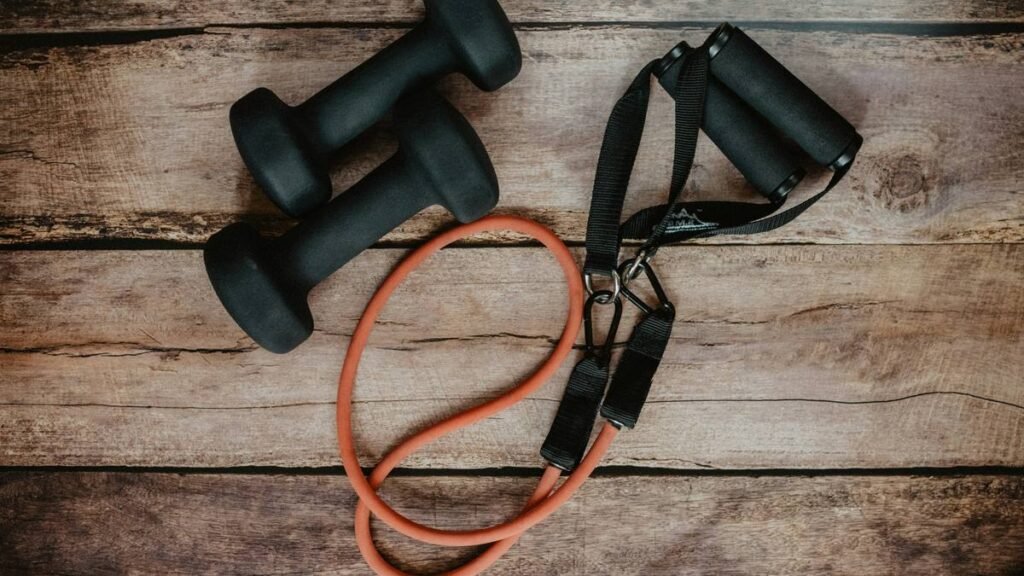
A stackable set gives you five tubes of increasing resistance that clip onto one pair of handles. Combined, they produce a wide range of usable load from a package that fits in a drawer. That range is the whole point — it is the only item at this budget that will still challenge you two years from now.
Two things worth checking before ordering. The carabiner clips should be metal rather than plastic, and the tubing should be fabric-sheathed or built from layered latex. Bare tubing is the component that eventually snaps, and it usually goes near the clip.
👉_Check the current price on Amazon [https://amzn.to/4fKRxOr]
What you can train with bands alone:
- Push: standing chest press, overhead press, banded push-up
- Pull: seated row, single-arm row, lat pulldown, face pull
- Legs: banded squat, Romanian deadlift, glute bridge, lateral walk
- Arms and core: curls, triceps pushdown, Pallof press, woodchop
2. Exercise mat — the cheap home gym essential most people skip
This is the purchase people skip and then regret within a fortnight. A yoga mat is 4–6 mm and designed for standing balance work, not for kneeling, planking or driving into a glute bridge on a hard floor. Strength training at home calls for 8–12 mm — thick enough that your knees, elbows and spine are not the limiting factor in the set.
If you train on a hard floor in an apartment building, the mat doubles as your noise buffer — which for many people is the difference between training at home and not.
👉_Check the current price on Amazon [https://amzn.to/4cs77w2]
3. Pull-up bar or suspension trainer — closing the pulling gap
Vertical pulling is the gap bodyweight training cannot fill on its own, and both options here close it. Which one suits you depends mostly on your doorframe.
A leverage-mount doorway bar hooks over the top of the frame and uses your own weight as the counterweight — no screws, no drilling, no damage. It needs moulding deep enough to sit on and a doorway inside the stated width range. Measure first; wrong doorway size is the most common reason these get returned.
A suspension trainer anchors over a closed door and delivers rows, assisted pull-ups, chest presses and single-leg work at adjustable angles. It is more versatile than a bar and far more forgiving if you cannot yet do a strict pull-up, because you set the difficulty simply by walking your feet forward or back.
Newer to training? The suspension trainer is usually better value. Already comfortable with a few pull-ups? The bar is hard to beat.
👉_Check the current price on Amazon [https://amzn.to/4hWRHn6 ]
4. Jump rope — the cheapest cardio equipment for a home gym
No machine delivers more conditioning per dollar or per square foot. A PVC-coated speed rope with adjustable length and decent bearings will outlast several pairs of running shoes, and ten focused minutes of skipping is a genuinely demanding session.
Buy one you can shorten. Ropes ship long, and a rope that is too long forces you to jump higher than necessary — which is how people end up with sore calves and the conclusion that skipping is not for them. Stand on the middle of the rope: the handles should reach roughly to your armpits.
Ceiling height is the real constraint. Under about 2.4 m of clearance, skip the rope and put the money toward sliders or a second band set instead.
👉_Check the current price on Amazon [https://amzn.to/4bxdAFS ]
Cheap home gym equipment to skip at this budget
Every item below is a defensible purchase eventually. None belongs in a first $100, and each has a specific reason why.
| Equipment | Why it waits |
|---|---|
| Adjustable dumbbells | Budget versions at this price are light enough that you outgrow them within months, and the adjustment mechanism is the first part to fail. |
| Ab roller | Trains one movement, and an advanced one. A band set covers core work more progressively. |
| Vibration plate | Marketing-led category with weak supporting evidence for strength or fat loss versus simply performing the movement. |
| Weighted vest | Only useful once bodyweight movements are genuinely easy. Bands add load sooner and in finer increments. |
| Flat weight bench | Consumes most of a $100 budget alone and does nothing without weights to pair with it. |
| Push-up handles | Helpful for wrist comfort, but a marginal gain competing against genuinely load-bearing purchases. |
A 3-day home gym workout plan using only this equipment
Three full-body sessions, roughly 35 minutes each. Rest 60–90 seconds between sets, and stop each set about two reps short of failure while you are still learning the movements.

Day A — push focus
- Banded chest press — 3 × 10–12
- Banded overhead press — 3 × 8–10
- Banded squat — 3 × 12
- Plank — 3 × 30–45 seconds
- Jump rope — 5 rounds of 45 seconds on, 30 seconds off
Day B — pull focus
- Pull-ups or suspension rows — 4 sets, as many reps as form allows
- Banded lat pulldown from the door anchor — 3 × 12
- Banded Romanian deadlift — 3 × 12
- Banded curl — 2 × 15
- Dead bug — 3 × 10 per side
Day C — legs and conditioning
- Split squat — 3 × 10 per leg
- Banded glute bridge — 3 × 15
- Banded lateral walk — 3 × 12 steps each direction
- Suspension or banded row — 3 × 12
- Jump rope — 10 minutes at a steady pace
How to progress: add a rep before you add a band. Once you hit the top of the rep range on every set, stack the next tube and drop back to the bottom of the range. General physical activity guidance from bodies such as the American College of Sports Medicine supports two or more full-body resistance sessions per week, so three sessions leaves useful margin for missed days.
Is a home gym under $100 worth it?
For a beginner or returning lifter, yes — comfortably. A $100 setup costs roughly what one to two months of a commercial gym membership costs in most markets, and it removes the two biggest reasons people stop training: travel time and scheduling. Consistency beats equipment quality by a wide margin at this stage, and the setup above removes most of the friction that breaks consistency.
It is worth less if you are already training heavy compound lifts near an intermediate ceiling, or if you specifically want to train barbell squats, deadlifts and bench press. In that case a $100 budget will not substitute for a barbell setup, and a gym membership remains the better spend until you can invest several hundred dollars in a rack and plates.
Home gym under $100: frequently asked questions
Can you build muscle with only resistance bands?
Yes, within limits. Bands provide progressive resistance and allow working sets taken close to failure, which is the primary driver of muscle growth. The constraint appears at the top end of strength, where advanced lifters eventually need heavier external load. For beginners and intermediates training consistently, a stackable band set is more than sufficient.
How much space does a home gym under $100 need?
Roughly 2 × 2 meters of clear floor, plus one doorway. That is enough to lie down fully, press overhead standing and step into a lunge. Jump rope is the exception and needs about 2.4 meters of ceiling clearance.
Are cheap resistance bands safe to use?
Generally yes, provided you inspect them. Check the tubing near the clips for cracks or thinning before each session, keep bands out of direct sunlight, and avoid stretching a band beyond roughly two and a half times its resting length. Replace any band showing surface cracking rather than trying to get a few more sessions from it.
Should I buy dumbbells instead of bands at this budget?
At around $100, a single pair of fixed dumbbells will be outgrown within months, and adjustable sets at this price tend to use fragile mechanisms. A band set covers a far wider load range for the same money, which is why it takes the largest share of the budget.What should I add first once I have more to spend?
A single adjustable kettlebell or a pair of moderately heavy dumbbells. They fill the one real gap in a band-based setup: heavy hinge and carry work. After that, a sturdy flat bench opens up additional pressing variations.Is a home gym cheaper than a gym membership?
Related home gym buying guides
- Best resistance bands for home workouts: full buying guide
- Best fitness trackers for the money
- Massage guns: what actually matters before you buy
- All Fit-Strive buying guides
How we research at Fit-Strive
Fit-Strive is an independent research site. We do not receive free products from brands, and no manufacturer pays for placement. Recommendations come from cross-referencing manufacturer specifications, verified purchaser feedback across multiple retailers, published training research and long-term durability reports — not from hands-on lab testing. Where a category involves real trade-offs, we say so rather than naming a single winner.
Written by Asif Shah, founder of Fit-Strive. Questions or corrections: hello@fit-strive.com.